Cool Designs to Draw on Cards
Design
When working for most TCG games one of the biggest benefits is the Style Guide. This is a certificate that has sketches, designs, and notes on how any given part of the world needs to look. This non but saves time in coming up with designs for the illustrators but it also helps keep the earth look and feel consistent across many unlike illustrators and illustrations. When working on your own project it is e'er a skillful thought to create concepts and designs of the things you want to illustrate earlier you kickoff your painting. The difficulty with designing while yous are painting is that both processes require your full attention and doing them at the same time splits that attention up into smaller parts. Good preparation goes a long way!
For this epitome, I had another paradigm already made which featured the sloth and the rider. The structure in the background is a simple geometric shape, specifically chosen to piece of work well with the composition. More on that afterwards when we talk about abstruse composition!
Sketching
Sketching is the 2d footstep in making a successful image. Afterward we have made or taken a look at the designs, we can and then starting time to combine them with the story. In TCG image creation we often work from a brief, too known as an Fine art Description. This only tells the states what the prototype should feature.
The brief for this image could, for example, look like this:
'Please show u.s. a Sloth mount with a rider in a desert / tropical rocky mural. In the background, we should be able to meet some signature structures also as some remnants of long-gone machinery. The mood should reverberate a sense of exploration and take chances'.
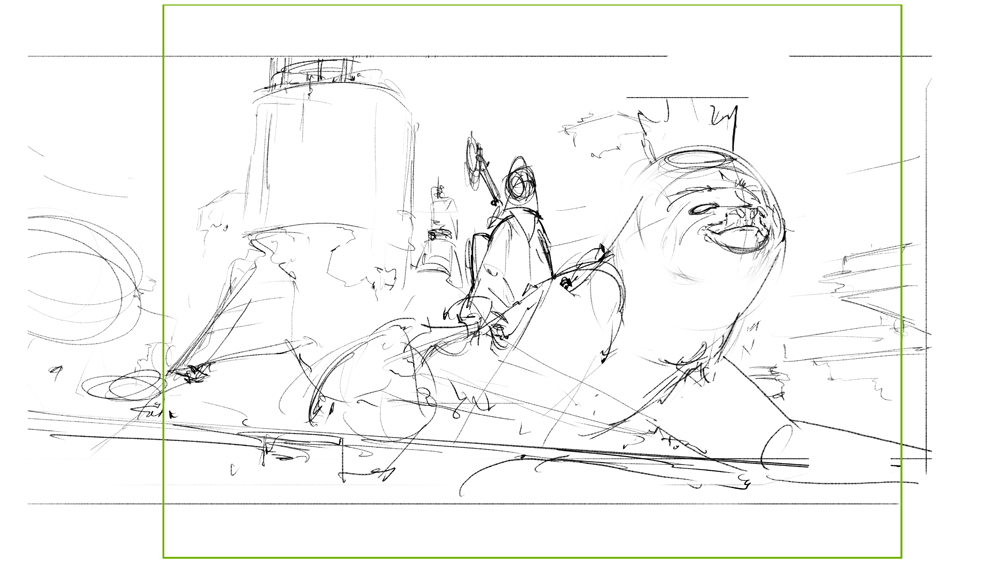
Now that we know the designs and the story, we can start sketching out our shot. Call up, sketching is nearly generating ideas and non making dainty images! In this case, I wanted the passenger to look out over the landscape, but we are not seeing it through their eyes. We expect up to them and they leave usa wondering what sights they behold! In the background, we can see some of the structures, and the rest will merely be there to help the composition. Let's take a closer wait at the limerick.
Abstract composition
Limerick is the framework that ties everything together. Information technology determines how the viewer's centre moves across the image from one important focal indicate to the next. In lodge to properly sell the story, nosotros need to know the most of import parts of the prototype. Sometimes this will be articulate, sometimes it's won't. It is our job equally illustrators to figure out what this is, and and so illustrate and position it in such a fashion that people who have no knowledge of the story can nonetheless sympathize what is going on.
This part is called 'Visual Storytelling'. While composition is part of the fundamentals of art, unfortunately, it'south not every bit straight forwards as some of the other fundamentals such as perspective, which has strict rules. In this sense limerick is very personal, it is about how you want and similar to tell stories. In that location are, of course, right and wrong ways to exercise information technology simply they take less to practise with rules and more to do with how articulate an image reads to the viewer.
One of the methods I like to use in gild to check my composition is to have a black and white image where the values are reduced to either being in lite or in shadow. The term for this is 'Shadow Shapes'. The ultimate skill is to convey an image simply with the shadow / low-cal shapes in their simplest course!
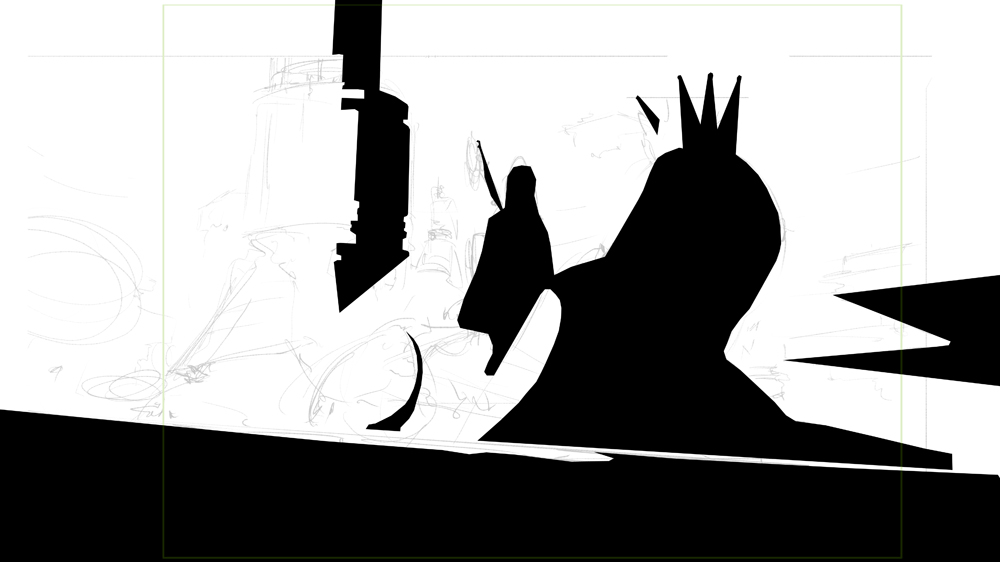
In the Blackness and White epitome, we can meet 3 repeating verticals representing the three focal points of the image. You lot can have more than that but it's best to stick to no more than than 3 focal points, otherwise, people won't know where to await! Some other thing nosotros can see is that each of the vertical shadows has plenty of room around them and that they stand alone. This is done intentionally to create dissimilarity. We'll talk more than most that afterwards when we talk about colour. For now, information technology is of import to recall that there are dozens of different types of composition, here are a few names for you to look up!
Circle composition, radial, L shaped, T shaped, South curve, and the Steelyard. Effort spotting them in dissimilar paintings. Equally a bonus, you can have a look at the composition image I added.
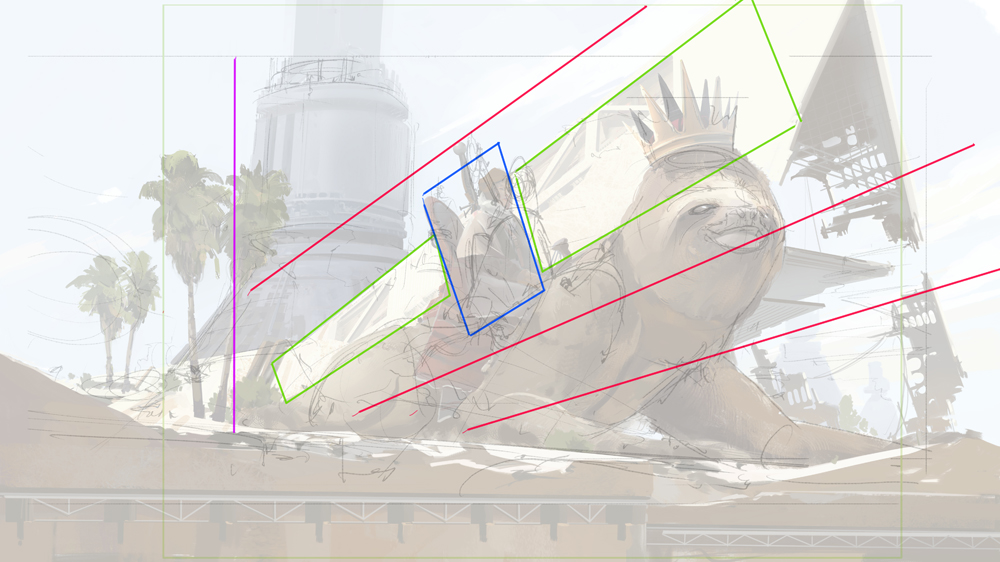
Reading left to right, the diagonal red lines (diagonals represent motion, they requite your image a sense of movement) frame the character and the sloth. To highlight the character even more they break the lines up past being oriented vertically instead of more than horizontal like the sloth and the structure correct behind them. The royal line represents the boundary for the more 4:3 aspect ratio of TCG games. Since I don't desire the viewer's centre to linger as well long on that left side, I added the copse which mark the starting point of the cerise lines. Think of it every bit a roadblock; the road continues behind it, of class, but we're not meant to get in that location!
Colors
I of the most frequently asked questions I get has to practise with colour.
How to pick the right color, how colors behave nether dissimilar lights, and so forth. These are all good questions and they share a mayhap unlikely answer; blackness and white values! If we accept an image and we take away all the colors, we are left with a grayscale image. Keeping your values noticeably clear and separated volition help the epitome read, which is incredibly important when making piece of work for TCG'south since the final product is oftentimes very pocket-sized. Information technology's one thing to have an image work large, and a whole other affair to have it work as a thumbnail! This is why I always accept a Hue / Saturation Correction Layer with the Saturation set to 0.
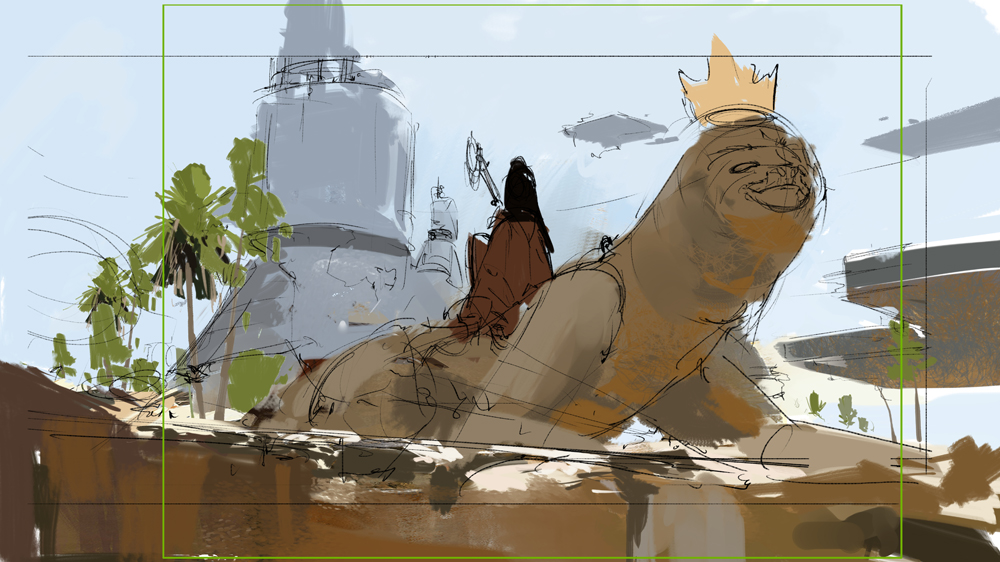
Subsequently that, I start blocking in my colors. In that location are various ways to do this and all of them are valid! You tin can look for a photo online or from your own reference library and have the colors from there, which I recommend to beginners. When you do this, make sure to check if the light is warm or cool! This will teach y'all a lot about how colors shift from a bright day, clouded, sunset, and even moonlight.
Some other is to take hold of a base colour; this requires some more studying and cognition but it's quite fun to try. Afterwards you have the base of operations color, yous will need two additional colors and values, the highlight and the shadow. A dominion of thumb is that in exterior settings, light is warm and shadows are cool, and in interior settings, the light is cool and the shadows are warm. Our big blue sky in acts as a big reflector, pushing in a lot of bluish onto our world. The sun brings in warm calorie-free and is much stronger, so the highlights fill with warm calorie-free, while the shadows trap the bouncing blue light. When studying colors, always make a note of the highlight, midtone, shadow, and bounciness low-cal.
Focus
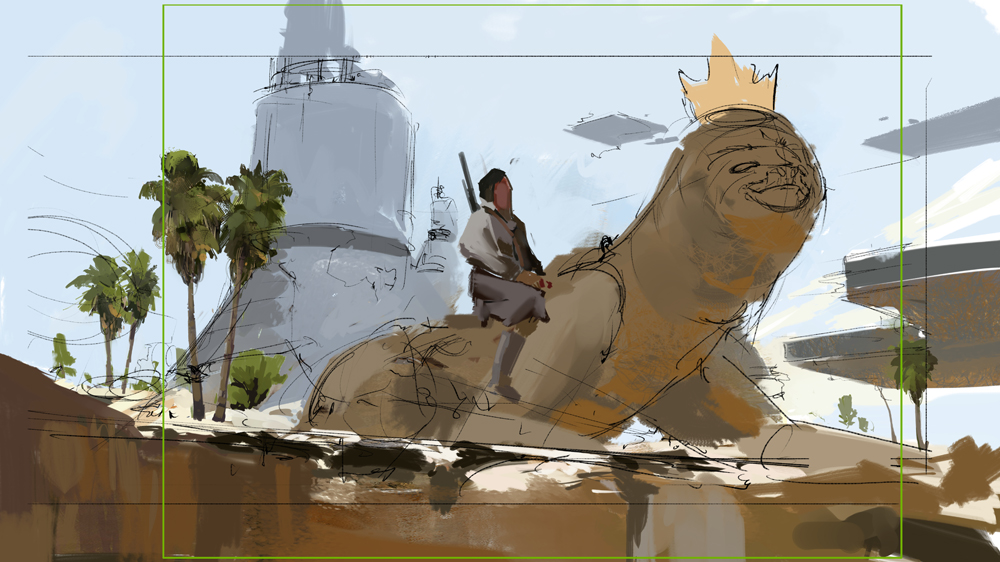
Now that the image is well underway, we must make sure we stay on track. Information technology is quite easy to stray from the original idea while making images and start adding details that actually exercise not belong! I certainly have this problem and I oftentimes add things in just to take them out. You can see this happening in the steps all the time.
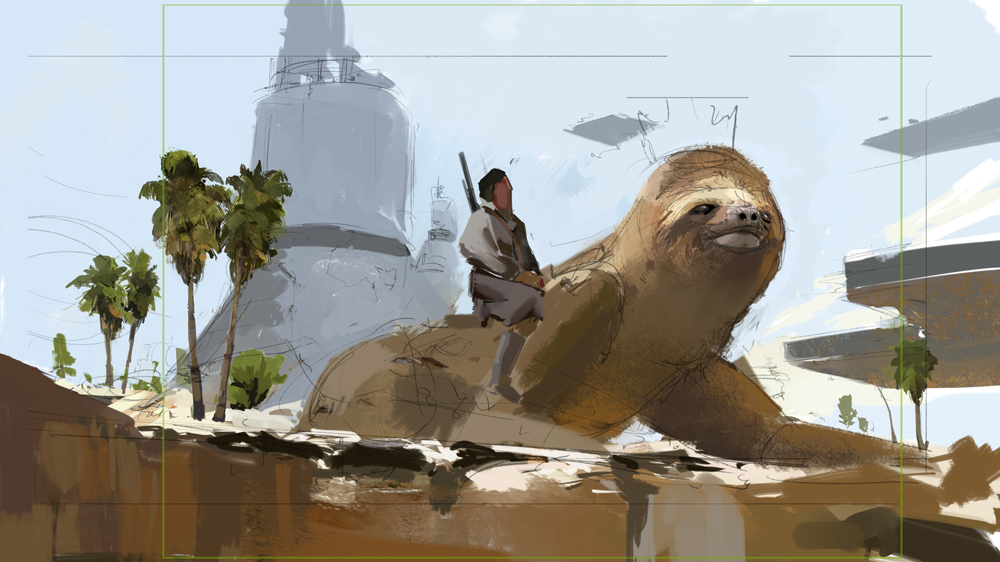
To prevent this, I check my focal points from time to time. These are the points of interest responsible for the most important parts of the story, and every bit such, they are entitled to the almost attention from the viewer. Ane way we tin can do this is by using contrast. Contrast is a vague give-and-take on its own, and in the globe of fine art, it can mean a lot of different things. For us, the almost interesting properties are concepts such as Night versus Light, Detailed versus Plain, High saturation color versus low saturation colour, and so forth. These points of dissimilarity push the viewer'due south middle to your focal point.
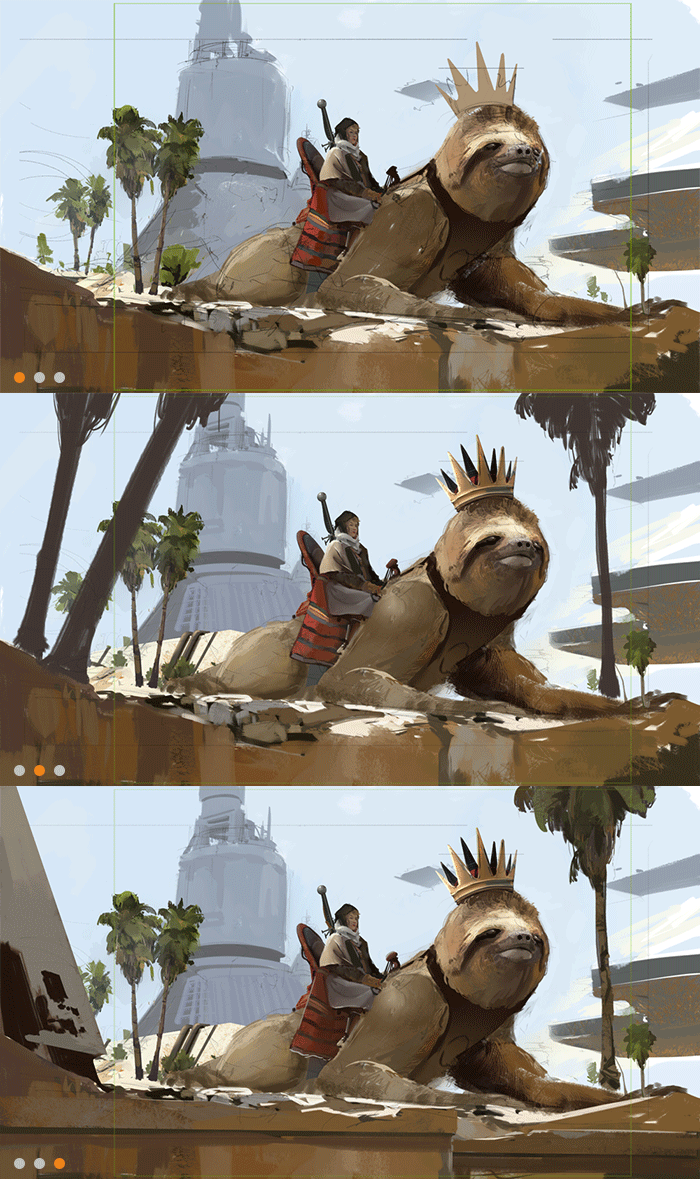
In this image, for instance, the passenger is quite dark and their environs are very bright. As they are the only night spot in a wash of light, they immediately take hold of your attention! Mission accomplished! The same is true for the sloth, and in a lesser way, for the tower in the background. The building there is not and so important, so the contrast with its surroundings is lower also. The higher the contrast, the more likely it will draw attention.
Make sure not to go overboard and add dissimilarity everywhere, it merely works if you are very selective.
Finish
Finishing an image is the terminal thing on the menu. If this was a overnice meal out it would be dessert! Not the most important part of the meal (to about), simply 1 that is quite enjoyable. In lodge to get the correct feel, I have created some of my own brushes! These range from having heavy texture and racket to existence quite clean. In that location is no correct or wrong way to use them so I'd say experiment away!
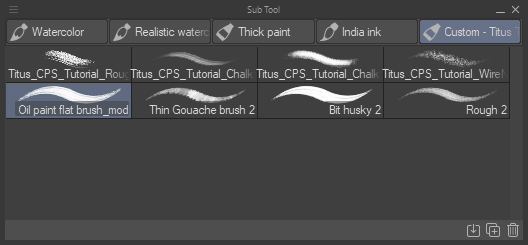
▲ My own brushes with Clip STUDIO Pigment
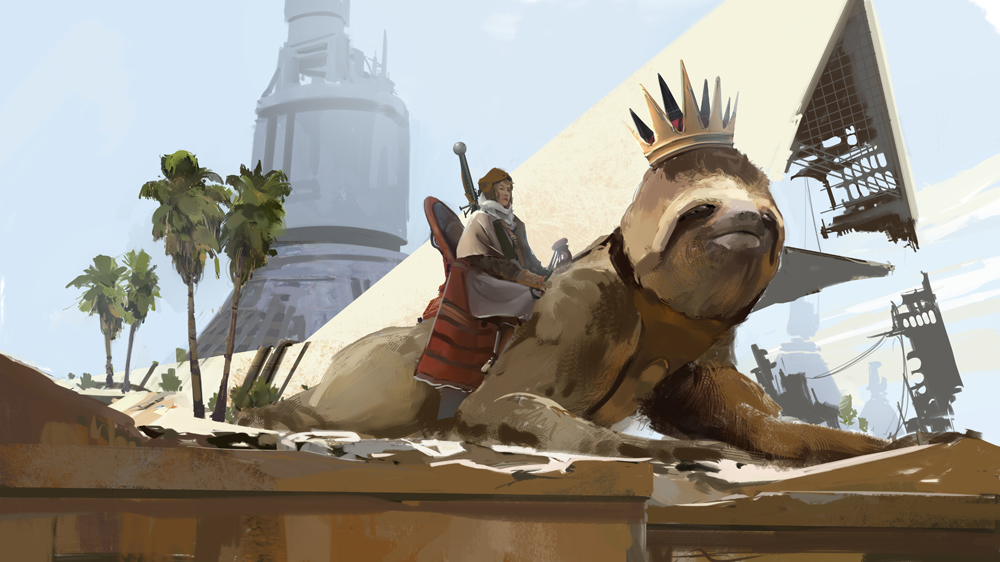
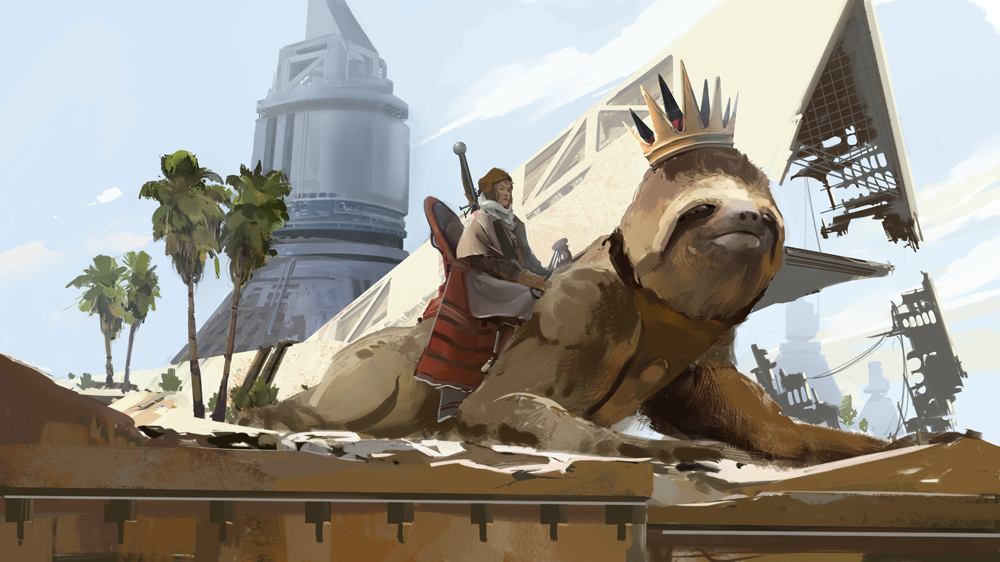
Make sure to go along using the Selection Tool to proceed things organized, for a while at least, and recall to name your layers when yous can. This is something I am quite terrible at merely I try. My opinion is that paintings should evolve naturally from their starting point every bit long as they go along true to the original idea and story. There is picayune left now but to sit down and advisedly putting some marks down. Make sure to stay economical with your brushwork, and consider the impact each brushstroke would take as if you were oil painting.
The image is washed when y'all are out of time or when you think it is done. Retrieve, a client pays yous a sure corporeality to get a painting done, then make certain to set up a daily rate for yourself and divide the price past the daily rate. That's how many days y'all have! Don't overwork yourself for a work client, that is a slippery gradient!
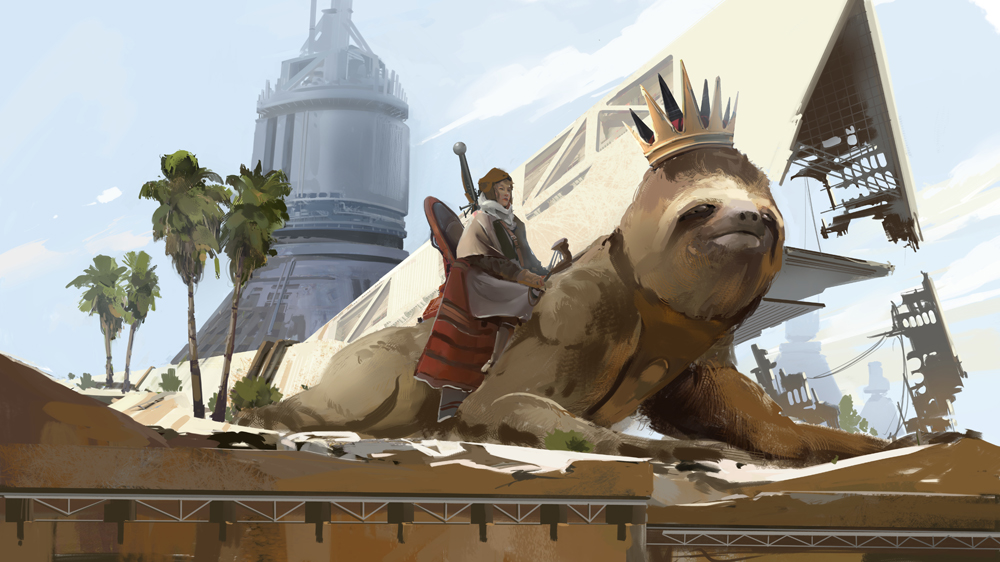
Summary:
To summarize, making an paradigm for a TCG client is all about clarity. Make certain your epitome reads very well by figuring out what the story of the image is. Next, select the story highlights and turn them into your focal points. Manage your focal points by clearly separating the values so they stand out. Use contrast where necessary to farther highlight the of import parts, and don't add item where none is required. Choose a composition that fits the story. Some shots are more dramatic than others, it's up to yous to pick the right 1. If you're stuck, have a wait at movies you lot like on that topic and see if you can study them. Manage your brush strokes as carefully as you lot can by existence precise, don't add more than than y'all need. Information technology's perfectly fine to add or have out elements all the time. Don't exist also precious about what yous paint, and make certain that it works for the image and story!
About the Artist
My name is Titus Lunter, I accept been an illustrator and concept artist since 2010. Since so I've worked on many AAA video game titles also as TCG games such every bit Magic: The Gathering, as well as Dungeons & Dragons. In that time I have shipped more than than 300 commissioned illustrations. I besides teach art fundamentals and how to deal with mental pressure of being an artist.
https://world wide web.artstation.com/titus
https://twitter.com/tituslunter
https://tituslunter.com/
Source: https://www.clipstudio.net/how-to-draw/archives/161230
0 Response to "Cool Designs to Draw on Cards"
Postar um comentário